
SUMMARY
A midlife birthday can pose a tricky crisis to navigate in life. The clichéd itch to buy the non-proverbial Harley, the ever smaller rounds to buy in for the Quizzy Rascals’ weekly, the Strava PRs drifting further out of reach every day. The purpose of this Adventure was to reroute these preconceptions. We were going to prove to our hero that, with a little help from his friends, life can well and truly begin at forty.
CONCEPT
There are times when it can take a great deal of effort to lash a unifying theme to the corners of our stage. Sometimes no concepts announce themselves; sometimes thousands compete for the limelight. This was not one of those times. The client, whom we shall call Anton, had revealed to us that he works for DeepMind (the team behind AlphaGo), is literate in Google’s programming language Golang, and is a skilled practioner of the ancient Chinese board game: Go. (He was also, by some margin, the most experienced puzzle-solver we’ve ever had the pleasure of designing for, so we knew we could go all-out!)
For anyone that has not played Go, it involves placing stones on a 19×19 grid and trying to surround the neighbouring stones of your opposition. For anyone that has played Go, the odds are pretty high that you have a Computer Science degree. Congratulations! If you have followed this train so far, then the odds are even higher that you are also familiar with John Conway’s famous gridded game from the 1970s: Game Of Life. Or, GO…L.
Suffice it to say, the concept was a go ahead.
PLANNING
Golang, Go, and Game Of Life are many great things. Natural seeds for an outdoor Adventure Hunt through Central London they are not. Moreover, owing to previously scheduled commitments, we only had four weeks to design, build, and test a full day’s worth of puzzle experience for a group of 10 seasoned adventurers.
When solving a puzzle, you can often feel the non-linear pull of exploring different avenues before eventually tugging upon the thread that draws you to the solution. Conversely, when designing a puzzle it stands to reason that the first step is to design the last step. A single room at the centre of the maze whence the correct journey should feel inevitable in hindsight. On this occasion, we had very quickly settled on the idea of a Go board resolving to a final state solution after applying a single iteration of Game Of Life. Conceptually it is a climax that ties together all the thematic elements of the day. Theatrically, it is a disaster.
And so began the lion’s share of the planning: how to dress up this stale denouement in a way that made a single person solving a board game feel like the pinnacle of human achievement.
You may have observed that none of this planning has yet addressed what most people would call “plot”. It is the choices we made at this juncture whereupon our approach to this adventure may split the puzzling community. Anton, a man of our heart, had made abundantly clear that narrative was going to be a pivotal criterion for his enjoyment of the day. A veteran of many Puzzle Hunts and seemingly every Escape Room in London, the standard fare of “we need to find the antidote to the Slytherol Neurotoxin” or “we need to divert Earth from a collision course with Asteriod C125-B” simply were not going to cut it on this occasion. The decks were stacked, leaving only one card available to us. A trump card so avant garde that no puzzle designer had yet dared play it. We are of course talking about using the American board game Game Of Life and the British cellular automaton Game Of Life as antagonistic metaphors through which to reconcile metaphysical compatabilism from the opposing camps of philosophical determinism and metaphysical libertarianism. Need I say more?
Early playtesting indicated I did in fact need to say more.
And yet, I shan’t. Instead, here is a snippet from the expository script performed by the Master of Ceremonies for the Adventure.
Hello. Welcome to the Wayfare Institute.
If you’re watching this, you’ve found your way to the starting point of what we expect will be a deeply illuminating Experience. We’ve been running these open weekends for some time now—longer than you might imagine—and I can tell you, not everyone makes it this far. You should feel good about yourselves. Cautiously.
My name is Connor Jay Whothon. I’m a Field Associate with the Institute, and I’ll be your guide today. Now—I know what you’re thinking. “What is the Wayfare Institute?” “Why am I standing in a park?” “Is this going to be weird?” The answers are: “don’t worry about it”, “because you’re here”, and: “define weird”.
This year marks what we call a quadragennial—from the Latin quadraginta, meaning forty. Every forty years, we open our doors to the world. It is, we believe, the most natural number of years around which to orient a celebration. You’ll understand why by the end of today.
We call this Experience The Game of Life—though we use the name ironically, and with considerable relish. You may know it as a board game: designed by a man named Klamer, whose vision of life is a series of fixed squares, prescribed milestones, and destinations from which no deviation is permitted. Collect the pieces, follow the path, arrive at the end. The Klamerites, as we call his philosophical descendants, consider this an accurate portrait of existence. We consider it a rather depressing one. Our Game of Life looks nothing like that. There is no board to follow. The virtues you’ll be uncovering today aren’t collected: they’re recognised. They already exist within you. We’re simply here to help you find them.
At the heart of our philosophy is a figure we call the Master of Routes—Blessed Be His Passage. It is believed—symbolically, of course—that every quadragennial, the Master returns to usher reality from one state to the next. From the old, the new emerges. From constraints, beauty. From chaos, order. Whether you take this literally or allegorically, the Institute would suggest that the distinction matters less than you’d think.
Plot? You bet we plot.


ADVENTURE
One of the advantages of working in theatre is collecting a large roster of trusted actors who can be deployed in different scenarios. Trying to guide 10 puzzle veterans through 9 levels of puzzle on a scorching weekend in one of the busiest cities in the world requires a unique set of skills. Fortunately, we knew just the actor for the job. Folarin, amongst his many accolades, is an experienced Dungeon Master (IYKYK). For us, this represents the perfect nexus of being able to sustain momentum through a plot, whilst allowing ample remit for side-quests and improvisation. From a directorial point of view, our first challenge was to deploy this secret weapon with as much initial effect as possible.
The Adventure began with our 10 puzzlers meeting at a predesignated rendezvous in Regent’s Park at exactly noon. A series of geographic clues wove them on an itinerary through this beautiful park, making the most of the historical Points Of Interest available. At each checkpoint, a video was unlocked via a QR code, steathily hidden around the location. Our actor, Folarin, would appear on each video and do three things: congratulate the group on current progress; expose the next quantum of plot; reveal a cryptic clue about the next location. After several iterations of this process, the Adventurers had been successfully tutorialised and should have gained a good idea about what to expect throughout the day. What they may not have been expecting is the star of the videos himself to emerge from the shrubbery whilst they were in the middle of watching the latest instalment. This rug-pull achieved its goal of subverting expectations and illiciting audible gasps. Folarin was able to verify that the narrative had been observed up to this point. His first set piece speech was to clarify the complex exposition that everyone had been gathered today in order to summon the Dominus Itineris—The Master of Routes—as he passes our realm on this Quadragennial. In non-trivial conditions, our actor landed the plane beautifully.
Now equipped with a Spirit Guide of sorts, our puzzlers were able to embark upon the Adventure Proper and we could relax, knowing we had a tighter control of location and timings. I would be lying if I said I do not still get an infantile thrill out of secret communication with a walkie talkie and ear-piece.
I mentioned that we had already established the mechanics of the final puzzle. Tradition dictates that the endgame must involve artefacts (either implicit or explicit) from each of the previous puzzles. This left us in the incredibly constrained situation of requiring 8 puzzles that resolve to a 9×9 bitmap. After far too many midnight brainstorms, we finally derived a shortlist of suitable candidates that matched these criteria. In the interests of brevity and not divulging all of our secrets, we’ll use a single example as a microcosm for the rest of the day.
The Thirsty Knight
Picture the scene: a location clue has taken you to a water tower in Regent’s Park. At the location you discover a mysterious wooden knight sitting on top of a mysterious chess board. So our adventurers found themselves at around 1pm on the afternoon of the 23rd May. Something doesn’t feel quite right. The chess board has an extra row and column. The mysterious knight seems to have something metallic affixed to it.

You mistake the metal ornamentation for a QR code and bring your phone to the hapless knight. At once, a website opens and downloads a (you guessed it) mysterious poem. How does the text relate to the grid? I invite you to pause here and try for yourself!


Observations:
- The icons on the chess board seem to reference words in the poem
- There are exactly 81 words in the poem
- There are lots of words that contain the substring “hoo”
- The board has been partitioned into an outer annulus and inner grid
- The text around the board seem to allude to a Knight’s Tour and leading a horse to water
I’m sure many puzzlers are familiar with the 8×8 Knight’s Tour puzzle. The goal is to traverse every cell on a chess board exactly once using only valid knight’s moves. Anyone who has tried to solve this will recall that any solution is not easily discovered. It is necessary to make ostensibly stochastic moves and eschew all hopes of symmetry. Who knew that the solutions to a 9×9 tour are significantly move aesthetically pleasing? Credit where credit’s due, Dan Thomasson made me aware of this pattern (https://ww.danthomasson.com/kt-art.html), which is also immortalised in the beloved Online Encyclopedia of Integer Sequences (https://oeis.org/A068614).

The poem itself describes a unique traversal: starting from the top left (”Northwest Flank”); traversing to the right (”Spirals Clockwise”); describing one ring at a time (”Trace Two Circles”).
The only remaining element is, as it were, water. This is where HOO comes in, otherwise thought of as H followed by 2 Os: H2O! If you trace the unique Knight’s Tour solution step by step, whilst reading the poem word by word, you will land on the icons in the correct sequence. For example, the typhoon in the centre of the grid is exactly the 58th word in the poem and the 58th step in the successful Knight’s Tour. By marking all the cells where the corresponding word in the poem contains the letters “HOO”, we get our ‘water’ bitmap. You can lead a horse to water…

Upon solving this puzzle, Folarin emerged and handed them a wooden board with their solution as an artefact to carry with them throughout the day. No prizes for guessing whether this will come in handy at some point in the future.

Now, I will simply have to ask you to imagine 7 more puzzles that resolve to a binary grid. Without wishing to reveal all of our secrets, some of these puzzles did involve interactions with the world in unexpected ways, including:
- picking up ‘lost items’;
- locating caches hidden in plain sight;
- interacting with pre-briefed members of the public;
- checking into private establishments.
Endgame
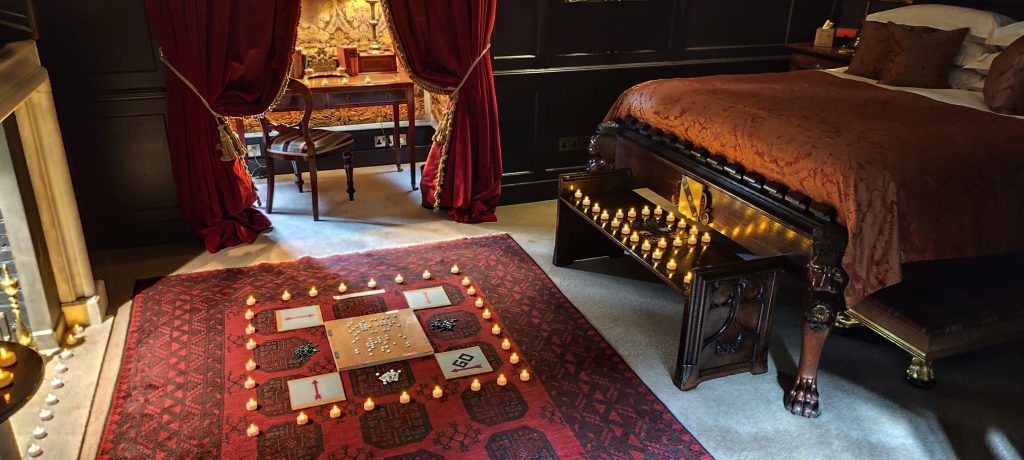
Six hours later, now equipped with a full complement of 8 boards, our heroes found themselves at the endgame. This is where we elected to vibesmax the budget on creating an atmosphere of utmostly-elevated stakes. You know, the typical level of stake required for an arcane ritual whereby the Master of Routes is summoned to this mortal realm.

Our adventurers were quick to realise that the markings on the central go board corresponded to the monopoly colours of the boards they had been collecting throughout the day. Here is a representative photo from our own playtesting.

The next steps will either be trivially obvious or unforgivably oblique depending on whether or not you are familiar with Conway’s Game of Life. The rules of Game of Life are incredibly simple, but can be used to generate incredibly exotic and unpredictable behaviours. For those that wish to play along, here they are:
- Underpopulation: Live cells with <2 neighbors die.
- Overpopulation: Live cells with >3 neighbors die.
- Survival: Live cells with 2-3 neighbors live.
- Reproduction: Dead cells with exactly 3 neighbors become alive.
For those that don’t want to play along and/or want to read on, here is the output if you apply those rules to the central grid.

Armed with a UV torch which had been provided as an extraneous prop to the first puzzle of the day, Anton was wise to shine the invisible light on the bottom row of the Go board:
QR CODE ON OTHER SIDE
The oldest trick in the book. In fact, if anyone ever builds an Escape Room for us in the future, please nail any props to the ground if you do not want me to immediately invert them in search of clues. The QR code was a link to a web app that we built for exactly this occasion. The rules of Game of Life may be very easy to state, but they are fiddly to implement. Not least when under duress in the midst of a critical summoning ritual. To this end, the app provided a slight fast-track that mitigated against any narrative inertia during this period.
For example, here is the result of inputting the initial state of the 9×9 grid on the bottom right.


Feel free to make use of this app for any of your 9×9 Game of Life activities you may have planned for this week.
It was now obvious (and hopefully significantly less tedious) for the adventurers to collaboratively propagate the state of boards they had assembled. Reading the letters clockwise around the central board in the order intimated by the corner pieces revealed the following string of letters:
FORTHAND
After a few head scratches, Anton had the correct instinct to prepend the monopoly “GO” grid (yes, another GO) and extract the following phrase:
GO FORTH AND…
In immaculate chorus, all ten adventures chanted the 8 letter solution together. The grid had been solved! The Master of Routes was surely on his way. A final chest was presented, unlocked by the 8 letter key.
And what treasure did it contain? What reward is worthy of 80 hours of collective puzzling? What single item could thematically conclude such an eclectic afternoon?
All together now: a bus ticket.
Before the bathos had time to fully permeate, the unmistakeable call of a vintage klaxon punctuated the room. Out of the window, our adventurers could see that they had successfully mobilised their ride to an evening of onward celebration. Anton, with a little help from his friends, had summoned The Master of Routes.

AFTERMATH
This puzzlehunt marked a step-change in our levels of ambition. We had set out to explore as many avenues of getting adventurers to interact with their city in as many unexpected ways as possible. We wanted to create the impression that the scope of the puzzle narrative went far beyond the single day experience. Having a skilled actor played a huge part in making this goal achievable. What’s more, this was the tightest turnaround we’ve committed to. Writing and producing what is effectively a day-long show within a month is unheard of, but this experience has set a precedent for what can be achieved when there is a clear goal.
The joy of coming up with ideas for puzzlehunts is realising how the only bounds on scope come from our own imagination. I’m sure many people have seen vintage routemasters in London. Not many people will have ever considered hiring one for a coup de theatre. It is easier to organise these things than you would expect! We now find ourselves exploring new locations with a distinctive lens of “I wonder if this could be used in a future adventure”. Just look around yourself: every blue plaque, every phonebox, every tube station is a potential treasure trove of puzzle content!
The main learning we took from this adventure was of a more philosophical bent. It can be quite uncomfortable watching people struggle on a puzzle that we’ve spent hours lovingly creating. When we think every possibility has been playtested and time margins have been tabulated with indelible ink, the urge to provide clues is almost irresistible. And yet, it should be resisted. The joy of puzzles, paradoxically, is not the solution. If that was the case, we would just read through solved sudokus or watch videos of people speed-running Portal. As with many things in life, the thrill comes from the struggle. The further it is possible to delay the resolution of the final state, the more value we get from that gratification.
Arguably, the most successful moment from this adventure was one we didn’t have to signpost at all. At some point near the end of the day, various people pulled out puzzles that hadn’t been fully solved. The adventurers organically formed into small groups and started parallelising their efforts across different domains with an energy that felt more like a Tech Hackathon than a piece of immersive theatre. And yet, it was this exact moment that we witnessed a group of adults rediscover the childlike joy of tinkering with different experiments. If this unwritten scene does not perfectly encapsulate The Game of Life, I’m not sure what does.